
The Homeowner’s Guide to Choosing Grass Seed
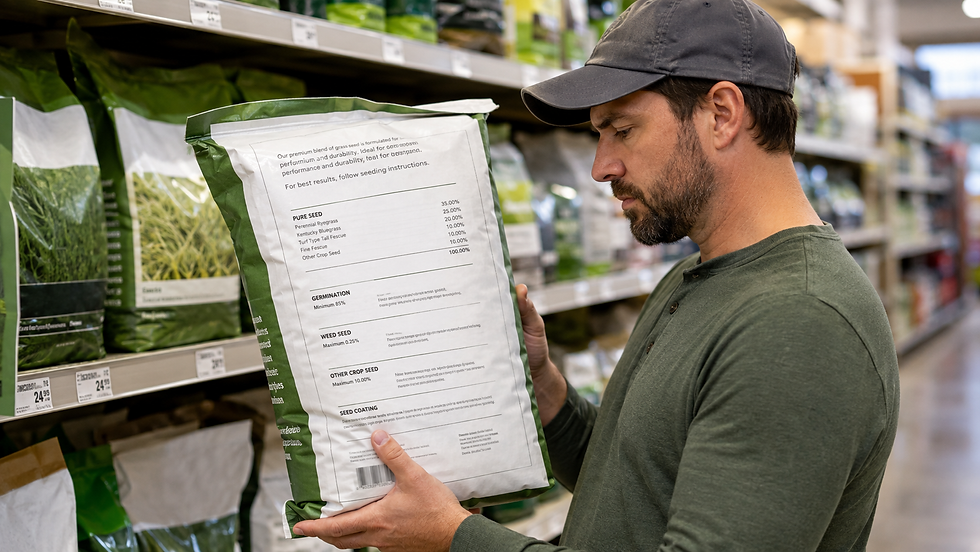
Walk into almost any home improvement store and you’ll find an entire aisle dedicated to grass seed.
Every bag promises a thicker, greener, healthier lawn.
Some advertise fast germination. Others claim to be premium quality or the perfect mix for sun and shade.
So how do you know which one is actually right for your lawn?
The answer isn’t found on the front of the bag.
It’s on the back.
The Seed Label Tells the Real Story
Every bag of grass seed includes a seed label that tells you exactly what’s inside. Learning to read that label is one of the best ways to make an informed decision before spending your money.
Here are the five things I look at whenever I compare grass seed.
1. Pure Seed
The first number I check is the percentage of Pure Seed.
This tells you how much of the bag is actually the grass listed on the label.
A higher percentage generally means you’re getting more of the grass you’re paying for. If the percentage is lower, part of the bag may consist of seed coating or other materials.
That doesn’t automatically make one product better than another, but it does help you compare products more accurately.
2. Germination Rate
The germination percentage tells you how many seeds are expected to sprout under ideal conditions.
For example, an 80% germination rate means about 80 out of every 100 seeds should germinate when conditions are right.
Remember, even high-quality seed needs moisture, proper soil temperatures, and good seed-to-soil contact to perform well.
3. Weed Seed
This is one line many homeowners never notice.
Yes, some grass seed contains weed seed.
Even though the percentage may be small, it’s still worth comparing between products. Lower weed seed percentages generally mean fewer unwanted plants introduced into your lawn.
4. Other Crop Seed
You may also see a line labeled Other Crop Seed.
These aren’t necessarily weeds, but they are plants other than the primary grass listed on the front of the bag.
Reading this section helps you understand exactly what you’re planting.
5. Seed Coating
One of the biggest misconceptions I hear is that coated grass seed is somehow “bad.”
In reality, many seed coatings serve a purpose.
They can help retain moisture, improve handling, and support germination during establishment.
The important thing to understand is that coating adds weight.
That means two 50-pound bags may contain very different amounts of actual grass seed.
When comparing products, don’t just compare the weight of the bag. Compare what’s actually inside.
Not All Tall Fescue Is the Same
Many homeowners are surprised to learn that not all tall fescue varieties are alike.
Kentucky 31 has been around for decades and still serves a purpose on large properties, pastures, and utility areas.
For most residential lawns in Southern Illinois, however, I recommend quality turf-type tall fescue blends.
Modern turf-type varieties typically offer:
A darker green color
A finer leaf texture
Better drought tolerance
Improved disease resistance
Better overall appearance
Excellent durability for everyday family use
Choosing the right grass variety is just as important as choosing the right seed label.
The Best Grass Seed Still Needs the Right Conditions
One of the biggest mistakes homeowners make is believing that buying a premium bag of seed guarantees a beautiful lawn.
The truth is, successful lawns are built long before the seed begins to germinate.
Healthy soil, proper timing, good seed-to-soil contact, consistent watering, and a little patience all play an important role in establishing healthy turf.
That’s one reason fall is my favorite time of year for lawn renovation. Warm soil temperatures combined with cooler air create ideal conditions for establishing new grass and encouraging deep root development before winter.
My Recommendation
If I were planting my own lawn here in Southern Illinois, I’d choose a quality turf-type tall fescue blend.
Not because it’s the most expensive option.
Not because the bag has the best marketing.
Because I’ve seen it consistently produce beautiful, durable lawns that hold up well to our climate and everyday family life.
Final Thoughts
The next time you’re standing in front of a shelf full of grass seed, don’t let the front of the bag make the decision for you.
Take a minute to flip it over.
Read the label.
Compare the facts.
A few extra minutes today can help you make a better investment in your lawn for years to come.
And if you’re unsure which seed is right for your lawn, Hanson’s Lawn Care is always happy to help homeowners throughout Centralia and the surrounding Southern Illinois communities make informed decisions about creating a healthier, thicker lawn.
Remember…
The front of the bag sells the seed.
The back of the bag tells the story.


